Experiment 01: Can one measurement station serve multiple hydroponic reservoirs?
Hydroponics, Measured · 21 September 2026 · Design and baseline update
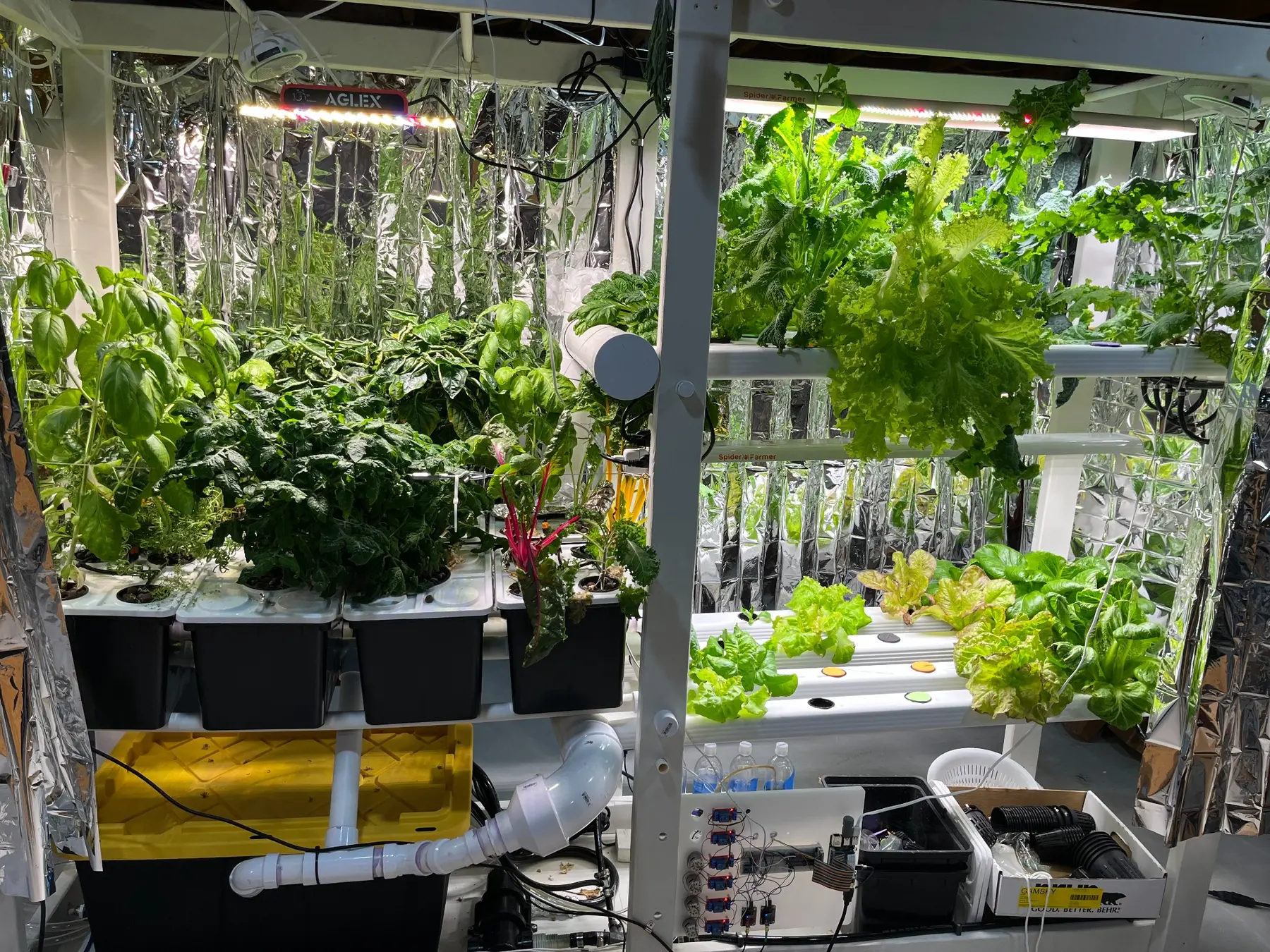
My current indoor system grows tomatoes and peppers in eight Dutch buckets and leafy greens in two levels of NFT channels. They share one nutrient reservoir. I want to split the crops into separate loops, but duplicating every pH and electrical conductivity (EC) probe for each reservoir would add cost and maintenance. This experiment asks whether one station can sample those reservoirs in turn and produce readings dependable enough to guide their individual controls.
The current system
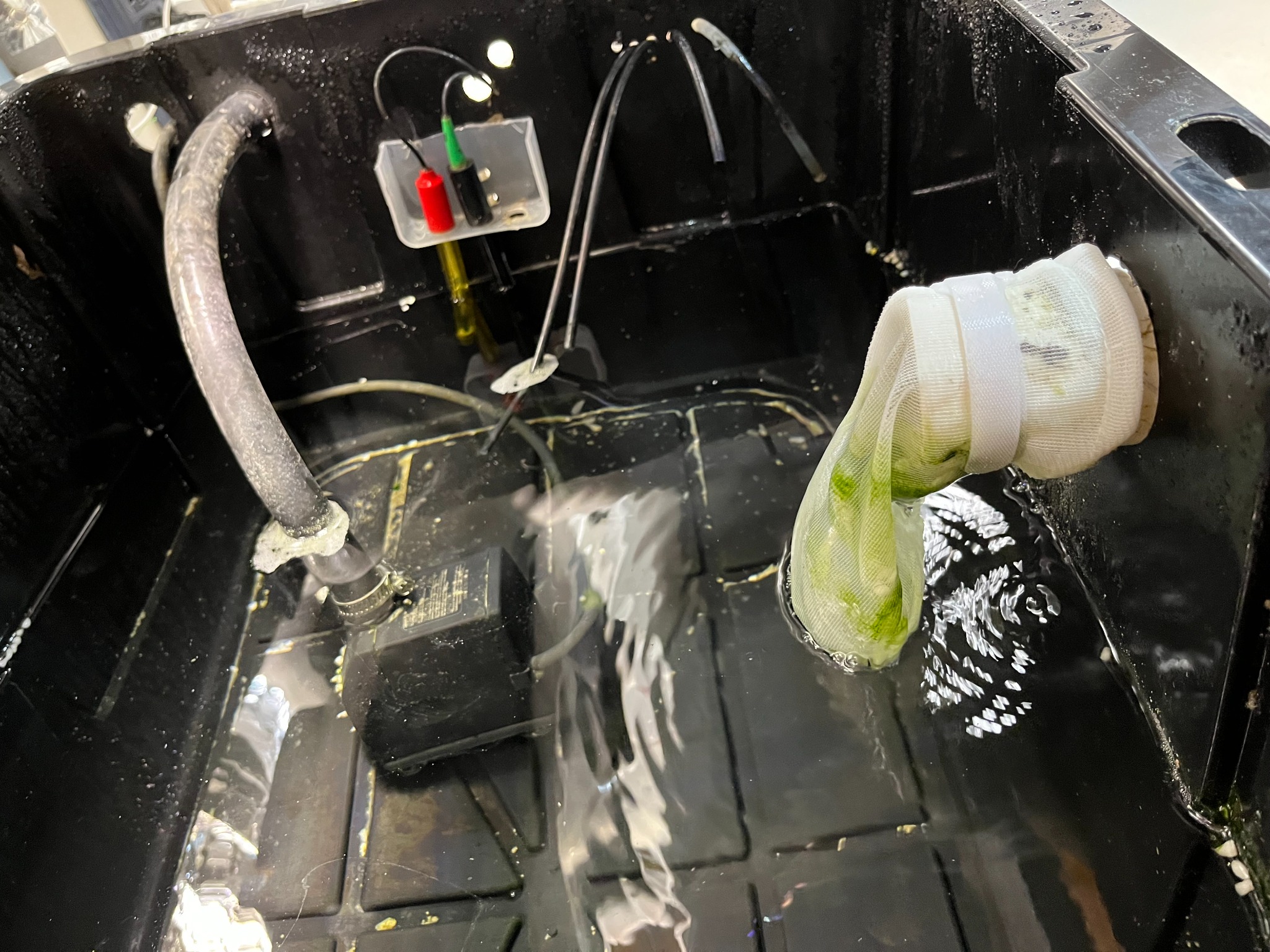
The fruiting side uses eight Bootstrap Farmer Dutch buckets for tomatoes and peppers. Leafy greens grow in two levels of four NFT channels. Both draw from the same nominal 27-gallon Greenmade tote, normally holding approximately 10 gallons of nutrient solution by my estimate. A submersible pump circulates the solution through a Jebao PU-18 clarifier, then a flow meter and filter. A float valve supplies top-off water.
Atlas pH and EC probes hang near the bottom of the reservoir. An ESP32 running ESPHome sends their readings to Home Assistant, which records circulation flow and controls five dosing pumps: pH up, pH down, and three nutrient stocks. The stocks are homemade concentrates of Masterblend (760 g/US gal), calcium nitrate (760 g/US gal), and Epsom salt (378 g/US gal), stored in reused Flora bottles. The Flora names in the controller are labels, not the current contents. These are reported stock preparation concentrations, not measured final reservoir concentrations. The probes were calibrated when installed but have not been recalibrated since. Their present absolute accuracy is therefore unverified; the historical data below describe recorded behavior of this system, with that measurement limitation.
What the existing system tells me
Before building a new instrument, I exported pH, EC, circulation flow, and available dosing-switch history from Home Assistant. I chose the three days from September 12 at 5:34 pm to September 15 at 5:33 pm Eastern daylight time as an initial baseline. This window ends before a September 15 measurement interruption.
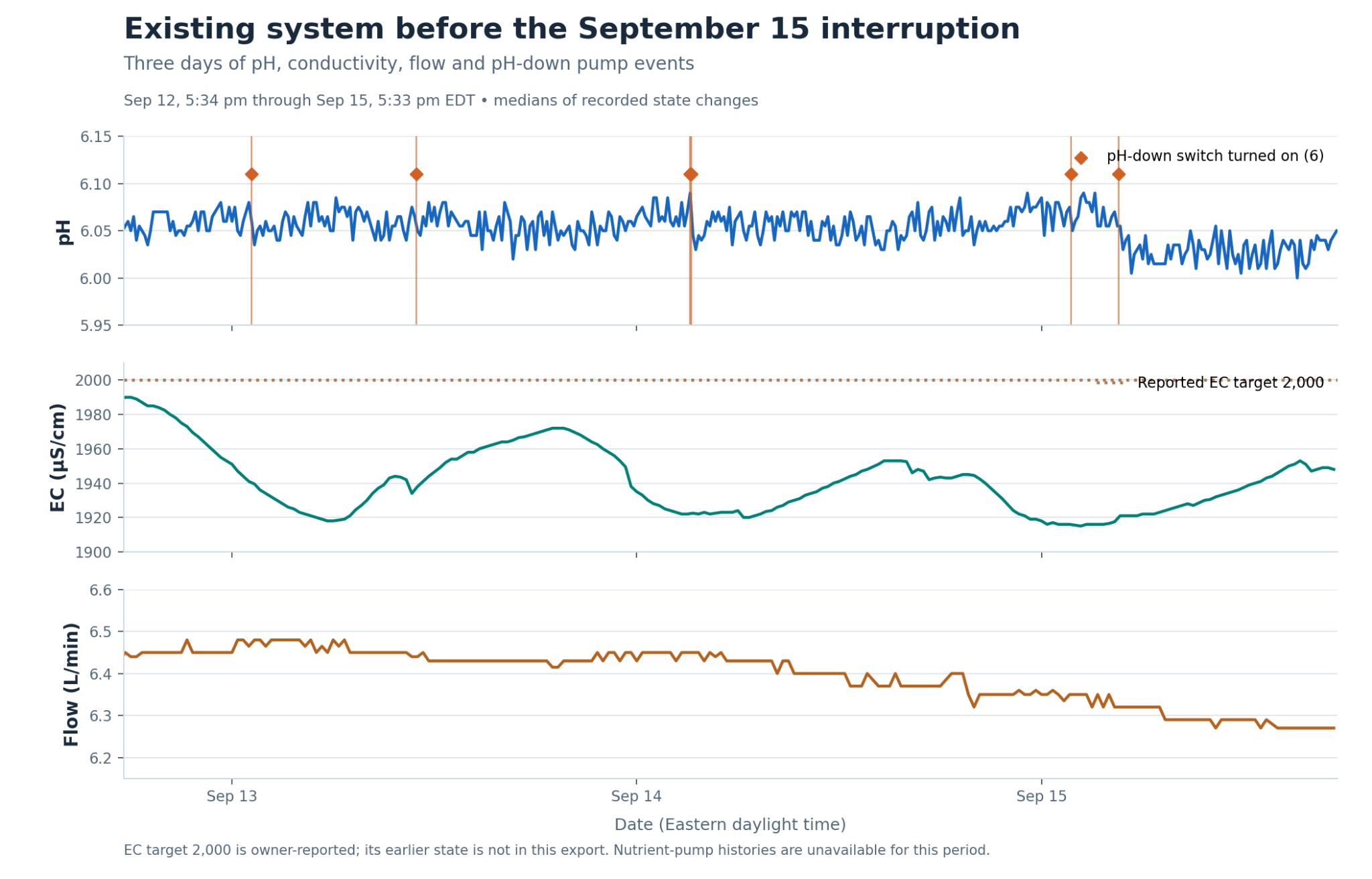
The pH stayed between 5.98 and 6.12. The pH-down pump switched on six times, each for about two seconds. EC cycled up and down between 1,914 and 1,991 µS/cm, while moving from about 1,989 to 1,948 µS/cm over the three days. Circulation flow also declined, from roughly 6.4 to 6.2 L/min. These are observations, not explanations of why the values changed.
The repeated EC swings raise a question for the next phase: how much of the variation is related to nutrient-solution temperature? Conductivity can change with temperature even if the solution's composition does not. I do not have a matching temperature history, so this remains a hypothesis. Water additions, plant uptake, mixing, and sensor behavior could also contribute. I plan to measure temperature alongside EC as the work continues.
The proposed measurement station
The station will draw a sample from one reservoir at a time with a peristaltic pump. The sample will pass through a flooded horizontal ½-inch PVC header, while the probes enter vertically from above. This arrangement keeps the future electrolyte-filled dissolved oxygen probe upright. The first build will measure pH and EC; capped positions reserve room for dissolved oxygen and temperature. The intended order along the flow is pH → dissolved oxygen position → temperature position → EC.
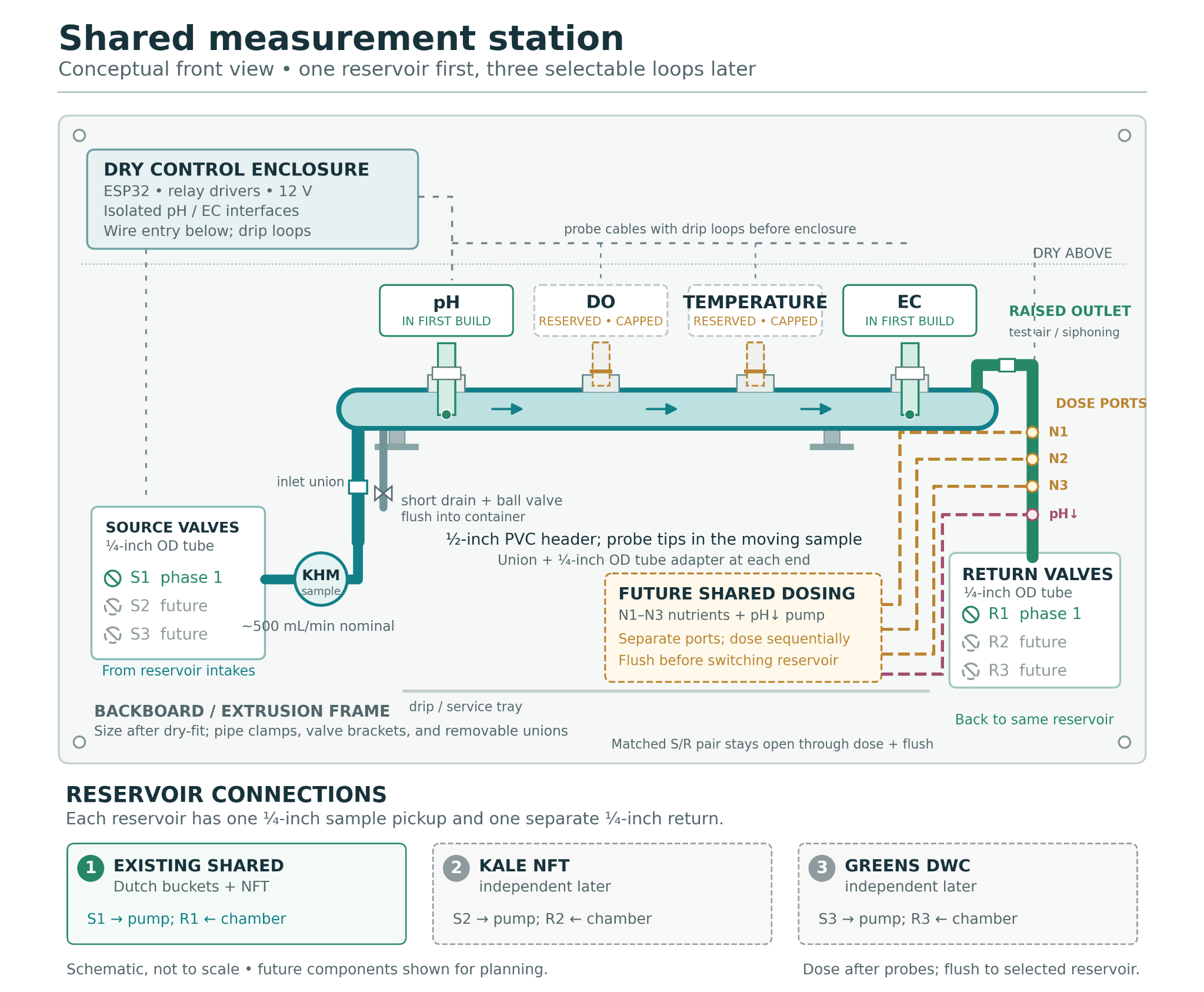
A selected source valve and matching return valve will keep each sample on the route to its own reservoir. The diagram places the controls above the wet plumbing, with room for unions, a drain, and a service tray. I will start with the reservoir already in use and add other routes only after the sampling path works consistently.
The longer-term plan also shares the nutrient pumps. Three separate nutrient lines and a pH-down line would inject into the common return after the probes and before the return-selection valves. The selected return then carries additions to the originating reservoir. This keeps dosing out of the measurement header and requires one set of feed lines instead of a separate set for every reservoir. The reservoir's circulation will do the bulk mixing. Shared dosing is a later stage, not a result of this first build.
What I will learn next
The first trial will ask whether the chamber fills reliably, the pH and EC readings settle, and one sample can be cleared before the next. I will compare the new path with the current system on the same reservoir and report what actually happens, including revisions that the build requires. Only after that will I try routing between reservoirs.
This entry records the design and the existing-system baseline. The new station is not operating yet, so it has no new-station measurement results. The next entry will show the assembled hardware and its first readings.